
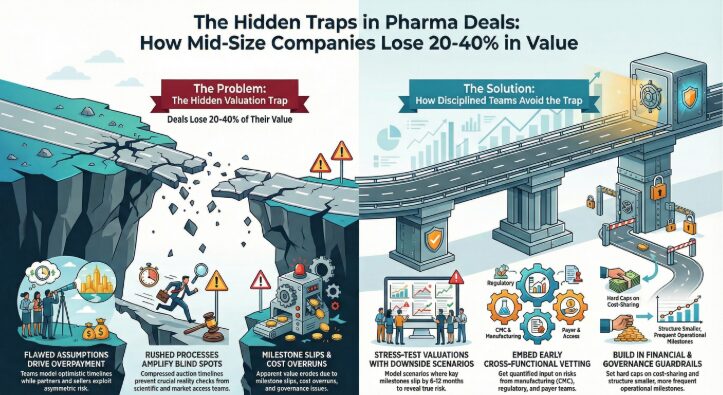
The Silent Valuation Trap in Co-Development Deals
Co-development deals often look balanced on paper—shared costs, shared upside, staged risk. Yet most mid-size companies underestimate how milestone structures quietly distort valuation by 20–35% before programs hit pivotal development. The trap emerges not from the headline economics, but from how backend milestones, governance rights, and cost-share mechanics interact under real clinical volatility. These issues routinely surface 12–24 months later—usually when it is too late to renegotiate and too early to exit without reputational damage.
This explainer breaks down the recurring structural flaws that create hidden downside risk in co-development partnerships and how disciplined BD teams anticipate and neutralize them during deal design—not after joint-governance challenges escalate.
Where the Valuation Trap Begins
The trap starts when BD teams model co-development economics linearly while the partner prices risk asymmetrically. Most mid-size companies focus on nominal milestone totals, not how probability weighting, timing slippage, and governance asymmetry alter real value. This creates a 15–30% valuation drift before any clinical readout.
- Underweighted probability adjustment: Milestones tied to Phase 2/3 initiation or enrolment often carry unrealistic timing assumptions—sliding by 6–12 months with no valuation re-cut.
- Backloaded economics: Seller-heavy structures push 50–70% of value into success-based milestones, making NPV look attractive while masking negative cashflow inflection points for mid-size partners.
- Governance asymmetry: The partner with stronger development infrastructure effectively controls study pacing, triggering milestones later than the model assumes.
Internal Mechanics That Amplify Hidden Downside
Inside mid-size organisations, co-development optimism compounds rapidly because teams treat milestone schedules as deterministic. In reality, 60–75% of co-development milestones slip by at least one governance cycle. That slippage is rarely converted into a new valuation, leading to an overstatement of returns and an understatement of resource exposure.
- Cost-share inflation: When timelines extend by 6–18 months, mid-size companies shoulder proportionally more operating costs while the partner’s milestone obligations pause.
- Payer and label risk unmodeled: Milestones often assume a clean path to label or pricing; payer-driven trial design changes create new cycles of work with zero milestone compensation.
- CMC delays: Tech-transfer or scale-up delays push manufacturing-readiness milestones back 9–15 months but rarely reduce partner economics.
Commercial Impact of Milestone-Driven Valuation Drift
The commercial impact emerges 18–30 months post-deal. Despite an apparently rational NPV at signing, total partner economics compress 20–40% due to milestone slippage, incremental cost-share exposure, and governance-driven delays. What looked balanced becomes structurally negative.
- Capital leakage: Additional development cost cycles can absorb 10–20% of planned commercialisation budgets before launch preparation even starts.
- Asymmetric upside capture: The partner often retains earlier inflection milestones, leaving the mid-size buyer dependent on late-stage triggers that slip most frequently.
- Board-level credibility risk: When finance recalculates realized economics vs the signed model, gaps of 20–30% undermine BD’s strategic judgement.
How Disciplined BD Teams Prevent the Trap
Best-in-class BD teams design co-development deals around actual operating behaviour—not milestone marketing decks. They quantify downside early, structure milestones to match realistic development pace, and embed triggers that prevent partners from externalizing delay risk.
- Milestone re-weighting: The most effective teams demand earlier, smaller, and more frequent operational milestones—not just late binary triggers.
- Delay-adjusted valuation: They model scenarios where 50–70% of milestones slip one governance cycle and reduce NPV accordingly.
- Cost-share guardrails: Hard caps on unplanned CMC, regulatory, and trial-expansion costs prevent creeping downside exposure.
- Governance fail-safes: They add escalation rights, independent review triggers, and development cadence KPIs to neutralise partner-driven slippage.
Checklist for Your Next Co-Development Structure
- Have we stress-tested milestone timing with a 6–12 month slip for each trigger?
- Do we understand which milestones the partner controls operationally?
- Have payer-driven study design changes been costed into the cashflow model?
- Is there a cap or reopener on cumulative cost-share exposure?
- Can we justify the milestone profile to the board using a single downside scenario slide?
EM / CEE Reality Check
In Central & Eastern Europe and CIS markets, reimbursement lag and tender-driven volume uncertainty amplify milestone risk. When global co-development models retrofit EM assumptions post-deal, 15–25% of expected returns evaporate within the first two commercial cycles. These markets require explicit milestone timing buffers and region-specific contribution modelling—not default global curves.
For related operational risks, see our explainer on launch readiness risk signals.