
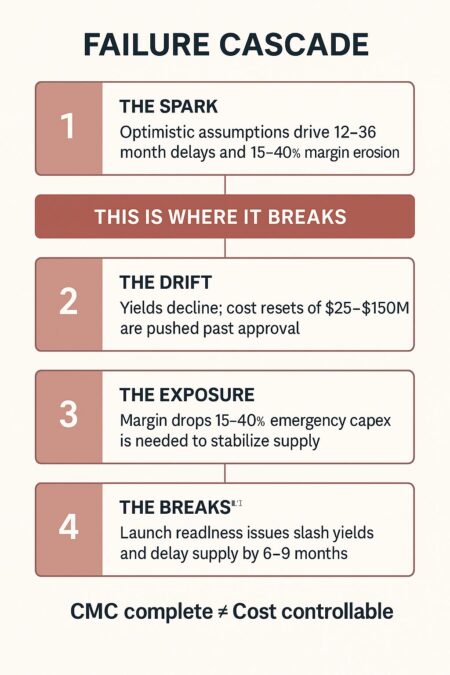
Across mid-cap licensing and late-stage acquisitions, “CMC-complete” assets routinely deliver 12–28% gross margin erosion within 6–18 months post-approval, triggering $40–120M downside adjustments and eroding IC credibility when cost resets surface after governance confidence has already been spent.
The Spark
The label “CMC-complete” is treated as a risk extinguished milestone. Yield, scale, and cost assumptions are locked at approval using pilot or limited commercial data. Teams assume that post-approval changes will be incremental—±3–5% at most—because validation packages are signed and regulators are aligned. This assumption feels safe because deviations rarely block approval timelines.
What is missed: approval validates comparability, not economic stability. Scale effects, vendor behavior, and lifecycle management costs remain structurally untested.
The Drift
Once commercial volumes ramp, small technical deltas compound. A 2–4% yield delta at scale can translate into 6–10% COGS impact. Secondary suppliers price in exclusivity risk. Cold-chain or sterile handling assumptions shift from development lots to sustained throughput, adding 8–14% logistics cost. None of these individually trigger escalation.
Governance drift begins when development KPIs remain in control, but commercial economics are no longer being actively stress-tested.
The Break
The break typically occurs 9–15 months post-approval when procurement renegotiates, deviations accumulate, or post-approval change controls are triggered. Validation amendments add 3–6 months to optimization timelines. At this point, margins compress faster than pricing or access teams can respond.
This is when leadership realizes that “CMC-complete” meant technically approvable—not economically resilient.
The Exposure
Margin shock surfaces in earnings guidance or alliance true-ups. For partnered assets, royalty bases shrink by 10–20%. For owned assets, launch curve assumptions miss by 1–2 quarters. Board confidence takes a hit because the issue was not scientific—it was governance. Internal trust erodes as teams argue whether the miss was foreseeable.
These resets are career-visible. They signal that diligence depth stopped at regulatory sufficiency instead of commercial durability.
How High-Maturity Teams Contain the Cascade
Disciplined teams treat “CMC-complete” as a transition, not a finish line. They run shadow P&Ls through scale scenarios 12–24 months beyond approval, pressure-test vendor economics, and pre-approve cost correction pathways. Yield and cycle-time assumptions are governed with the same rigor as price and access.
Critically, these teams separate approval readiness from margin readiness, preventing optimistic development assumptions from becoming locked commercial truths. For launch-stage risk framing, they align this work with launch readiness risk governance rather than post-hoc fixes.
Risk Cascade Checklist
- Model COGS sensitivity at ±2–5% yield across 3 volume tiers before approval.
- Pre-negotiate secondary supplier pricing triggers beyond pilot scale.
- Quantify post-approval change controls with 3–6 month delay scenarios.
- Run a shadow commercial P&L 12–24 months post-launch.
- Assign IC ownership for margin, not just approval milestones.
EM / CEE Manufacturing Reality Check
In EM and CEE supply chains, margin shock is amplified. Localization requirements can add 10–18% cost. Yield variability is higher due to equipment heterogeneity. Currency exposure alone can swing COGS by 5–12% within a year. Assets labeled “CMC-complete” in core markets often enter EM without governance recalibration, accelerating the same cascade faster.
Join Weekly Pharma BD Signals for decision-grade insights that prevent deal-room surprises.