
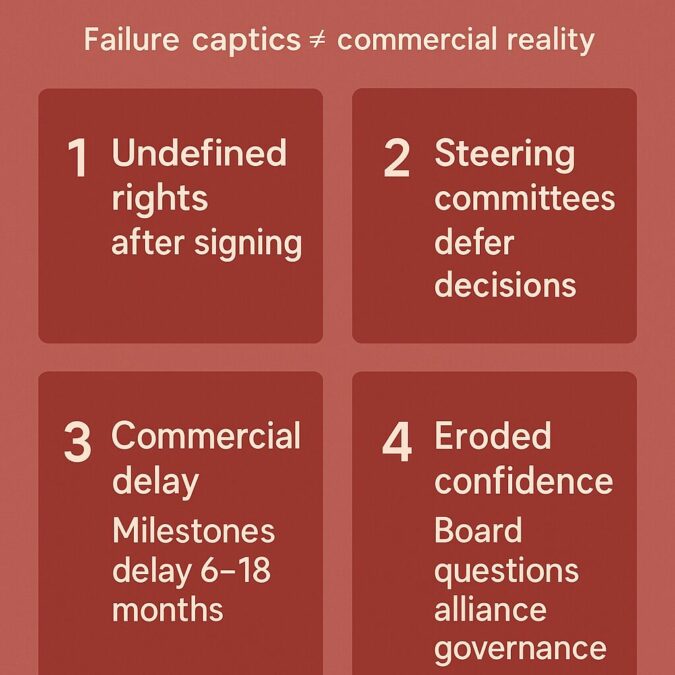
Undefined control rights after signing quietly destroy 10–30% of deal value, delay milestones by 6–18 months, and erode board confidence when “strategic partnerships” stall without a clear escalation owner.
Hook paragraph
Alliance failures rarely announce themselves. They fade. Steering committees meet. Minutes are taken. Decisions are deferred. What looked like alignment at signing becomes paralysis once money changes hands.
Where the Drift Starts
The drift begins when contracts emphasize economics over authority. Term sheets celebrate headline value while leaving operational control “to be agreed in governance.” After closing, both parties protect optionality. No one owns the call.
Common fault lines include development plan changes, CMC investments, and geographic sequencing. When neither side has final say, every adjustment becomes a negotiation. Six weeks turn into six months. Momentum dies without a single formal dispute.
Internal Mechanics
Decision limbo is not a people problem. It is a rights architecture problem. Joint Steering Committees (JSCs) are designed to align, not decide. When voting thresholds require unanimity or supermajorities, dissent becomes a veto.
Escalation paths are often cosmetic. Contracts specify escalation “to senior management” without timelines or default outcomes. The result is silent value erosion of 5–10% per quarter as milestones slip and spend continues.
Commercial Impact
The commercial damage compounds. Delayed development pushes peak sales out by 12–24 months. Competitive windows narrow. Internal forecasts quietly haircut NPV by 15–25% while external narratives remain unchanged.
Boards notice the gap between signed value and realized progress. Leadership credibility suffers when alliance updates sound procedural rather than directional. Trust erodes—not between partners, but internally.
How Disciplined Teams Correct the Drift
High-maturity BD teams design control, not just collaboration. They hard-code decision rights by domain—clinical, CMC, spend thresholds, territory adds—before closing. They define who decides, how fast, and what happens if agreement fails.
Critically, they quantify delay risk. Governance models include downside scenarios showing 6–12 month slips and 10–20% value loss, forcing accountability at IC and board approval. Post-close, alliances move faster because ambiguity was priced and resolved upfront.
Deal-Room Checklist (5 items)
- Assign single-point decision authority by workstream, not committee.
- Define escalation timelines with default outcomes after 30–60 days.
- Link spend approvals to milestone ownership and accountability.
- Model value erosion for 6–12 month decision delays pre-IC.
- Re-test governance against 2 adverse change scenarios before signing.
Related execution blind spots often surface at launch—see Launch Readiness Risks.
EM / CEE Reality Check
In EM and CEE alliances, decision limbo is amplified. Local adaptations, pricing corridors, and supply commitments require rapid calls. When global partners hesitate, market entry slips by 12–24 months and local teams disengage. EMs do not forgive governance ambiguity—they punish it faster.
Join Weekly Pharma BD Signals for decision-grade insights that prevent deal-room surprises.