
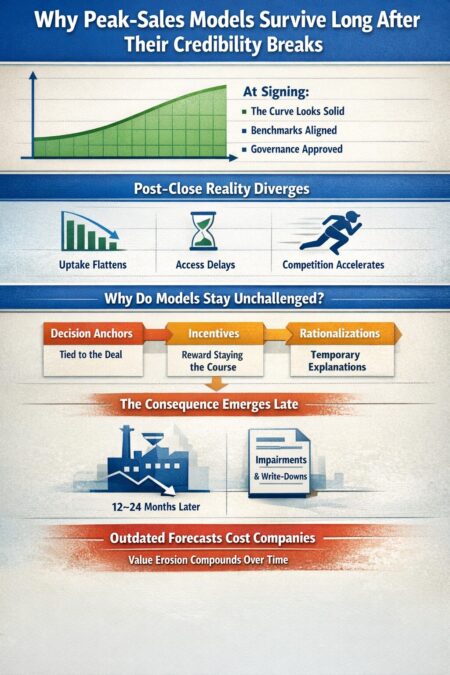
At signing, the peak-sales model looks solid. Assumptions are defensible. Benchmarks are cited. The curve supports the upfront, the milestones, and the investment memo. Governance signs off.
Post-close, the story starts to change. Not dramatically. Quietly.
Early uptake comes in below plan. Market access stretches beyond forecast. Competitor timelines compress. None of this triggers a formal reset. The peak number remains untouched.
Peak-sales models rarely collapse in one moment. They erode while staying officially alive.
The early divergence everyone sees
Within the first 6–12 months post-close, most BD and alliance teams see the same signals. Sales force feedback doesn’t match the curve. HTA sequencing pushes first meaningful revenue to the right. Tender exposure emerges earlier than expected.
These are not edge cases. They are execution realities. Yet the model stays intact.
The reason is not lack of data. It is governance inertia.
Deal-day models become decision anchors
Once a transaction is approved, the peak-sales model becomes more than a forecast. It becomes a justification artifact.
Investment committees, portfolio reviews, and board updates are all anchored to the deal-day rNPV. Reopening the peak assumption feels less like model maintenance and more like questioning whether the deal should have been done at all.
That is a hard conversation to initiate internally.
As a result, governance processes default to variance explanations instead of assumption resets.
How rationalization replaces recalibration
When performance misses the curve, explanations are offered. Launch learning. Temporary access delays. One-off competitive noise. COVID hangover. Channel inventory effects.
Each explanation sounds reasonable in isolation. Most are directionally true.
The issue is accumulation.
What was framed as a temporary deviation becomes persistent underperformance. But because the peak number remains fixed, the gap is treated as timing noise rather than structural miss.
Teams are incentivized to manage around the model, not challenge it. Budget cycles reward staying on plan. Alliance governance rewards stability. No one is rewarded for shrinking the peak.
Why incentives quietly protect the number
Once milestones, resourcing, and portfolio priority are tied to a peak-sales outcome, revising it downward has consequences.
Lower peak means slower payback. Slower payback means tougher capital allocation conversations. Tougher conversations mean reputational risk for the original deal sponsors.
So the organization protects the number. Not explicitly. Structurally.
By the time a formal reforecast is unavoidable, 9–18 months of value erosion have already compounded.
Where the consequence finally shows up
The correction usually arrives late. Often 12–24 months post-close.
Impairments surface. Portfolio reshuffling begins. The narrative shifts from “temporary headwinds” to “revised long-term expectations.”
The asset did not suddenly change. The data had been pointing there for quarters.
What changed was the organization’s ability to keep defending the original peak.
The real cost of defending outdated forecasts
Defending an outdated peak-sales model does not preserve value. It compounds overpayment.
Capital continues to be deployed against a curve that no longer exists. Opportunity cost grows. Management attention is misallocated. Course correction options narrow.
Disciplined BD groups treat peak-sales models as living instruments, not deal-day relics. They separate reassessment from blame. They reset assumptions early, even when uncomfortable.
That discipline is what prevents quiet erosion from becoming visible impairment.
Subscribe to the Weekly Pharma BD Signals newsletter for execution checklists and post-close deal breakdowns.