
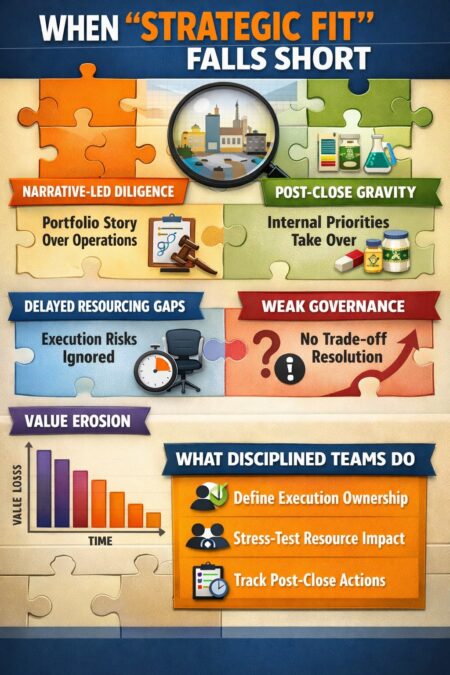
The deck said “strategic fit.” The IC approved. The press release landed. Twelve months later, the asset is quietly deprioritized, milestones slip, and portfolio reviews start using softer language like “optional,” “non-core,” or “revisit later.” What looked aligned at signing unravels not because the science failed, but because the fit was narrative-led rather than execution-tested.
This failure mode shows up repeatedly in Pharma BD & Licensing. Teams convince themselves the deal fits the portfolio story, but the post-close operating reality tells a different story. By the time that gap is visible, value erosion is already locked in.
Strategic fit is usually defined too early
Most “fit” arguments are made during sourcing and term sheet alignment, not during execution planning. The asset fits the TA. It fits the platform. It fits the growth narrative. What often goes untested is whether it fits how the organization actually deploys capital, talent, and attention after close.
BD groups are incentivized to frame alignment around portfolio slides, not around year-one resourcing fights. That means questions like manufacturing priority, clinical ops bandwidth, or regional launch sequencing are deferred. The deal closes with a clean story, but without an execution owner who has both authority and budget.
Narrative-led diligence crowds out operational truth
Diligence timelines are compressed. Scientific risk gets attention. Legal risk gets attention. Operational friction rarely does. Teams rely on management narratives rather than stress-testing how the asset will compete internally.
Key diligence gaps often include tech transfer realism, CMC scale-up sequencing, and the actual availability of clinical and regulatory teams in the first 6–12 months post-close. When these issues surface later, they are reframed as “integration challenges” rather than what they are: mispriced execution risk.
Post-close, portfolio gravity takes over
Once the ink is dry, assets stop living in BD decks and start living inside portfolios. This is where strategic fit claims are tested brutally. Internal programs with political capital, legacy brands with revenue pressure, and late-stage assets with near-term milestones all exert gravity.
If the licensed asset does not have a protected slot, it loses time immediately. Study starts slip. Tech transfer waits. Market access work is deferred. These delays rarely trigger formal escalations because no single decision looks irrational in isolation. Over 9–18 months, however, cumulative slippage compresses rNPV materially.
Governance was designed for signing, not for execution
Many alliances are governed as if alignment at signing will persist automatically. Joint committees meet. Slides are exchanged. Decisions are deferred upward. What is missing is a hard mechanism to resolve internal trade-offs when priorities collide.
Without predefined escalation rights and consequences, the partner asset becomes the path of least resistance. It is easier to delay a partnered program than to slow an internal flagship. Strategic fit rhetoric does not survive this asymmetry.
Value erosion is gradual, then sudden
In the first six months, the impact looks manageable. A few weeks here. A quarter there. By month twelve, launch curves are re-modeled, milestones are pushed, and royalty timelines move out. The write-down conversation usually happens only after 10–30% of expected value has already leaked away.
Importantly, this erosion is rarely attributed to the original fit logic. Teams describe it as market change, operational complexity, or external disruption. The root cause—overreliance on narrative fit instead of execution fit—remains uncorrected.
What disciplined teams do differently
Experienced BD organizations invert the process. They define execution ownership before they define strategic fit. They force explicit answers on who loses resources if this asset wins. They quantify internal competition during diligence, not after close.
These teams also build post-close scorecards that track time-to-first-action, not just milestone achievement. If key steps do not start within agreed windows, governance triggers are activated early, while value can still be protected.
Strategic fit is not a story to sell a deal. It is a claim that must survive portfolio reality. Most write-offs happen because that survival test was never run.
Subscribe to the Weekly Pharma BD Signals newsletter for execution checklists and post-close deal breakdowns.